Spanish I
La Rutina Diaria
In this module you will be learning all about daily routine and how to use reflexive verbs, transitions, and comparisons to tell what you do throughout the day and in what order. You will also get a great review of la hora y la ropa.
You can download a full copy of this module's key terms from the sidebar on the right.
You will have opportunities to practice your understanding of these terms throughout the module.
Listen to your Key terms -
Below you will see what Jen said to her teacher as she talks about her day.
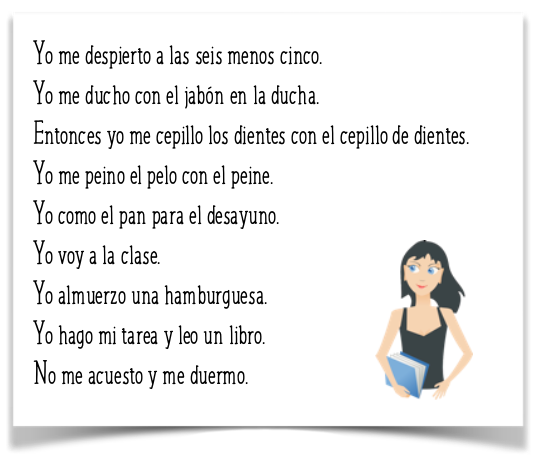
Now, based on what Jen said, match the picture to the sentence.
This is a very preliminary introduction to reflexive verbs. You will learn this concept much more in depth in Spanish II, however, learning the basic concept now will really help you later on!
Here's the gist:
Reflexive verbs tell an action that someone is doing to themselves (i.e. I wash MY hair. SHE brushes HER teeth) and these verbs have 2 PARTS.
Here are some examples:
Because this is an introduction, all of the verbs you will need for this module have been conjugated for you including both parts in the vocabulary list.
Want more help? Watch the video below and then try the practice exercises.
Video Source
Review words that signal transitions of time. Then complete the additional activity that follows.

Ben is adjusting nicely in México but his schedule is quite different here than it is at home. Read the 2 paragraphs below;one is about his typical day in Atlanta and the other is about his typical day in México. Then put the sentences in order based on what time the actions occur. Think about how his day is similar and different based on his schedule!
Mi día típico en Atlanta
Mi día típico en Oaxaca
Now it's time to put his day in order. Be careful! There are 2 missing items from each set! You'll need to read closely to make certain you are putting them in the right order.
You have already learned the verb TENER (to have). TENER is a very important verb. It is used to express something one "has to" do. It is also used in many expressions that do not translate easily to English. These are called IDIOMS.
 TENER + QUE + INFINITIVE means that someone "has to do something". "Tener" will be conjugated appropriately for the person doing the action and the second verb (in the infinitive) will express the action that they "have to do". Don't forget "que"! This is a 3 part verb!
You will know learn about those idioms and how to use TENER with QUE. When using Tener + que, you must conjugate it correctly and use the infinitive of the action verb:

HAY + QUE + INFINITIVE means that "one must do something" or "it's necessary". This compound verb is very simple in that you do not even need to conjugate anything. "Hay" stays the same because it refers to "one" which is vague and then the second verb (in the infinitive) will express the action that they "must do". Don't forget "que"! This is a 3 part verb!
Review Activity 1:
Review Activity 2:
Escuchar (Listening)
 To complete this assignment first you need to read the scenario below, then you will listen to the recording. You can download a copy of the questions that follow from the sidebar on the right. Then include your answers and submit your assignment when complete. You may need to listen more than once!
Cuidar a los niños (Baby-sitting)
You have promised your next-door neighbor that you will take care of her children this afternoon from the time they get off the school bus until she gets home after a dinner meeting.
[Your neighbor speaks virtually no English, knows that you are a good Spanish student and prefers to communicate with you in Spanish.]
She is very careful about her children, so she has written everything out and then called and left a message to your cell phone's voice mail box. When you get to the house, you see that the children have spilled something on the written message and parts are missing. Listen to the voice message and fill in the blanks as to what the afternoon and evening's schedule is.
Los niños llegan a casa a las ___________.
Para beber hay __________ y ____________.
Susana no puede beber ________________.
Para comer hay ______________________.
Para jugar afuera hay ___________ y _____________.
En caso de lluvia deben ______________ o ____________.
La cena es a las ____________.
En la cena comen _______________ y ____________________.
Los guisantesse calientan en _____________________.
__________ y _____________ quitan la mesa y ponen los platos en el lavaplatos.
Empiezan la tarea a las ______________.
Se preparan para acostarse a las ______________.
No necesitas ayudar los con _____________ ni ________________.
Necesitas ayudar con ______________________.
Se acuestan a las _______________.
Voy a regresar a casa a las ______________
You've already learned this easy future tense using "ir + a + infinitive" but here's a review. To tell something that you or someone else "is going to do" you use this 3 part verb form.
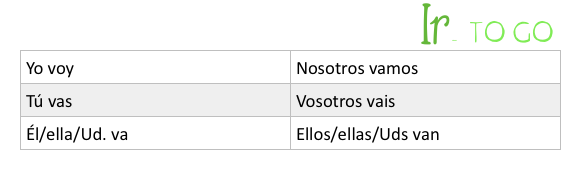
Here's a review of the verb "ir = to go"
The second part of this 3 part verb is "a" then another verb in the INFINITIVE.
Review the folowing terms. Roll your mouse over them in order to see its definition.
Vocabulary and Grammar Project
 To incorporate the vocabulary and grammar you have learned in this chapter, you will be required to complete a project.
 Scenario:
While in Nicaragua working as a volunteer for Habitat for Humanity, you do not feel well and need to make an appointment to see a doctor. Tell the doctor's receptionist who you are, at least 4 symptoms you are experiencing, and how long you have had the symptoms. Also, tell at least 5 parts of your daily routine so that the doctor can use that information to help with the diagnosis.
Be sure to check with your teacher first if you have any other ideas of tools to use. Please read the requirements very carefully before you begin to make sure that you have all the required components (vocabulary, grammar, audio, images). Submit your completed assignment when finished.
Now that you have completed the initial assessments for this module, review the lesson material with the practice activities and extra resources.