Spanish I
Los Fines de Semana
In this module you will learn all about how to talk about your weekend and your free time. You will be using the simple future tense and direct object pronouns. You will also begin to learn the "preterite", or past tense, to tell about what you did in the past.
You will explore the following:
You can download a copy of your key terms from the sidebar on the right. Then listen to the audio file to hear these terms pronounced.
Listen to your Key terms -
 What does Mario like to do in his free time?
Before Jen left for Spain she received an e-mail from her Spanish-speaking keypal. Before she writes back to him, she wants to make sure that she understands what he has written to her. Please read the e-mail that Mario has sent to Jen and then select whether the statements about Mario are true or false.
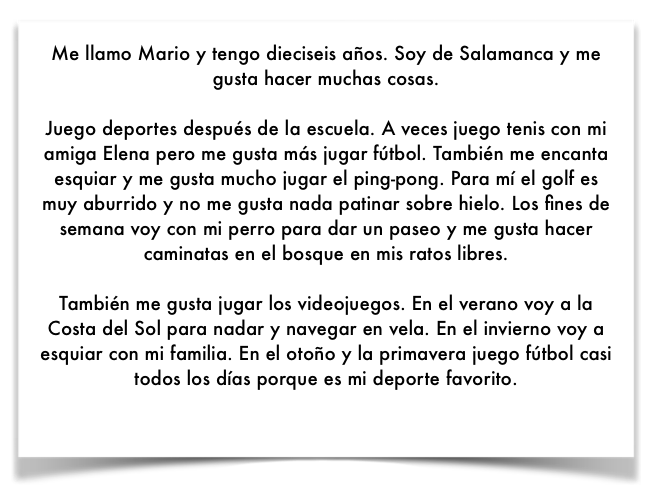
Directions to Students: You will now read 10 sentences about Mario in English.
Please select True or False about the sentences.
Conversar (Speaking)
 Lee el texto y responde. (read the text and answer the questions in SPANISH)
Es muy bonita y muy histórica. En mi ciudad hay un centro comercial con tiendas, parques, muchos museos y un castillo. ¡Me gusta mucho! Cuando llueve, hago mis deberes y veo la televisión o escucho música en mi dormitorio. Cuando hace buen tiempo, voy al centro comercial con mis amigos y hago ciclismo en los parques. Este fin de semana, el sábado voy a ir al castillo con mi hermana. El domingo voy a ir al estadio.
Remember:
 Ir + A + Infinitive is an easy way to talk about the FUTURE! This is a 3 part verb:
Part 1: A form of "ir"
|
Voy |
Vamos |
|
Vas |
Vais |
|
Va |
Van |
Part 2: A
Part 3: Verb in the infinitive; whatever action will be done.
Here are a few examples:
Be sure to check out the resources in the sidebar for more information!
Now you try! ¡Te toca a ti!
 Listening Comprehension
Ben has written a script for an educational video. View the video that he worked on with his classmate and then answer the questions that follow to test your comprehension.
Video Source
In Spanish, there are 2 forms of the past tense. In this lesson, you will learn about one of those forms - The Preterite. The Preterite tense is used for completed actions in the past.
Make a note of the correct conjugations for ar verbs in the preterite forms:
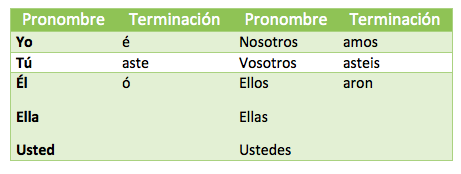
Ejemplo: Ella habló por teléfono ayer
Vocabulary and Grammar Project
To incorporate the vocabulary and grammar you have learned in this chapter, you will be required to complete a project.
¡El Mejor Fin de Semana del Mundo!
 Best weekend ever! You are so excited about the upcoming weekend. In this project you will be using the simple future tense "ir + a + infinitive". You will use "ir + a + inf" to tell what you will do this weekend.
 You must include a minimum of 6-8 complete sentences en español using the vocabulary terms and grammar from this module. (Example: El sábado que viene yo voy a leer el libro para la clase de inglés.)
Be sure to check with your teacher first if you have any other ideas of tools to use. Please read the requirements below very carefully before you begin to make sure that you have all the required components (vocabulary, grammar, and images).
The Direct Object Pronoun replaces the direct object in Spanish. Basically, the direct object is the item in the sentence that receives the action of the verb.
Ejemplo: Susana tira la pelota. [Susana throws the ball.]
Direct object: la pelota
Direct object pronoun: la
Sentence [revised]: Susana la tira.
The direct object answers the question what or whom, based on the sentence:
Now that you have completed the initial assessments for this module, review the lesson material with the practice activities and extra resources.