All preterite
Pretérito
The preterite is used for actions in the past that are seen as completed. Use of the preterite tense implies that the past action had a definite beginning and definite end.
Ejemplo:
- Marcos habló con la profesora.
- Marcos spoke with the teacher.
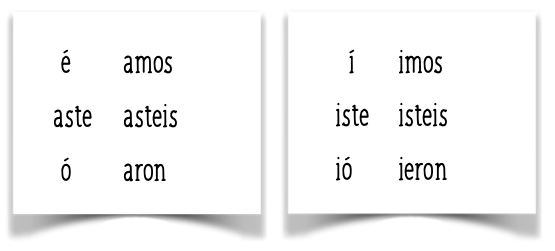
To conjugate verbs to preterite tense, you drop the -ar, -er, and -ir. Then, add the following endings:
Irregular Preterite Stems
- Estar/estuv-
- Hacer/hic-
- Poder/pud-
- Poner/pus-
- Querer/quis-
- Saber/sup-
- Tener/tuv-
- Venir/vin-
- Andar/anduv-
- Decir/dij- -
- Traer/traj-
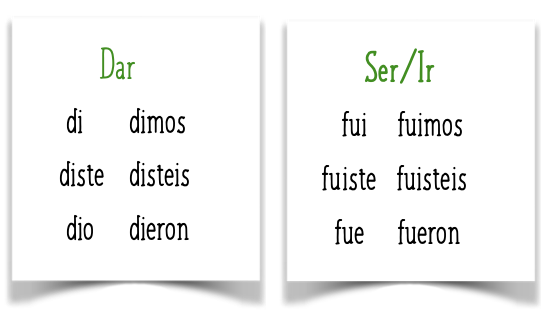
Dar, Ser & Ir
-CAR, -GAR, -ZAR Verbs in the Preterite
- Verbs that end in -gar change g to gu
- Verbs that end in -car change c to qu
- Verbs that end in -zar change z to c

Stem-changing Verbs in the Preterite
-ar and -er verbs that change their stem in the present tense do not change in the preterite. They are conjugated just like other regular preterite verbs.
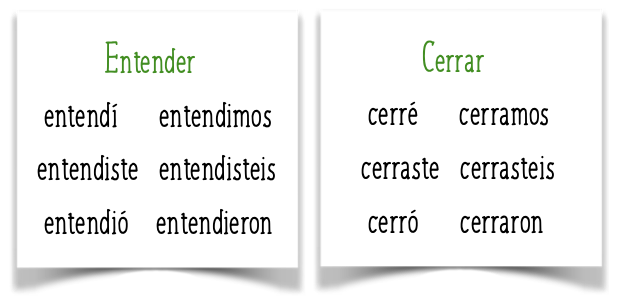
-ir verbs that change their stem in the present tense do change in the preterite, but in different way. They change e:i and o:u in the third person, singular and plural.

Vocabulary and Grammar Project
 To incorporate the vocabulary and grammar you have learned in this chapter, you will be required to complete a project.

Jen and Ben have had a great time during their study abroad experiences. They both put a lot of thought into choosing their host country and they are already planning where to go next! For this project you are going to plan your own future study abroad experience. It must be a Spanish-speaking country.
Here are some questions to answer:
- Where would you go? ¿A dónde vas?
- Why are you choosing this city? ¿Por qué escoges este país?
- What will you do there? ¿Qué haces allí?
- What cultural activities do people do in this city? ¿Cuáles actividades culturales hace la gente allí? (museos, conciertos, bailes, festivales, ...)
- What will you likely eat? ¿Qué vas a comer?
- What's the weather like? ¿Qué tiempo hace?
- What do you need to pack? ¿Qué necesitas traer?
- Where will you fly into? What airport? ¿A dónde vas a volar? ¿Cómo se llama el aeropuerto?
- How will you get around? ¿Cómo viajas por la ciudad?
- What currency do they use? ¿Cómo se llama la moneda?
Here are the requirements for this assignment:
- First, choose your host country/city.
- Use as much travel vocabulary as possible (around 20 terms).
- You will also need to go back to previous modules in order to incorporate vocabulary you have learned throughout the year.
- View the sites located in the sidebar resources. You can also find travel sites on your own or reach out to your instructor for additional resources.
- Choose your method of presentation. Check with your instructor first if you have any other ideas for presenting your material.
- Be sure to answer all of the questions listed above,
- Include audio and images in your presentation.
Submit your completed assignment when finished.